
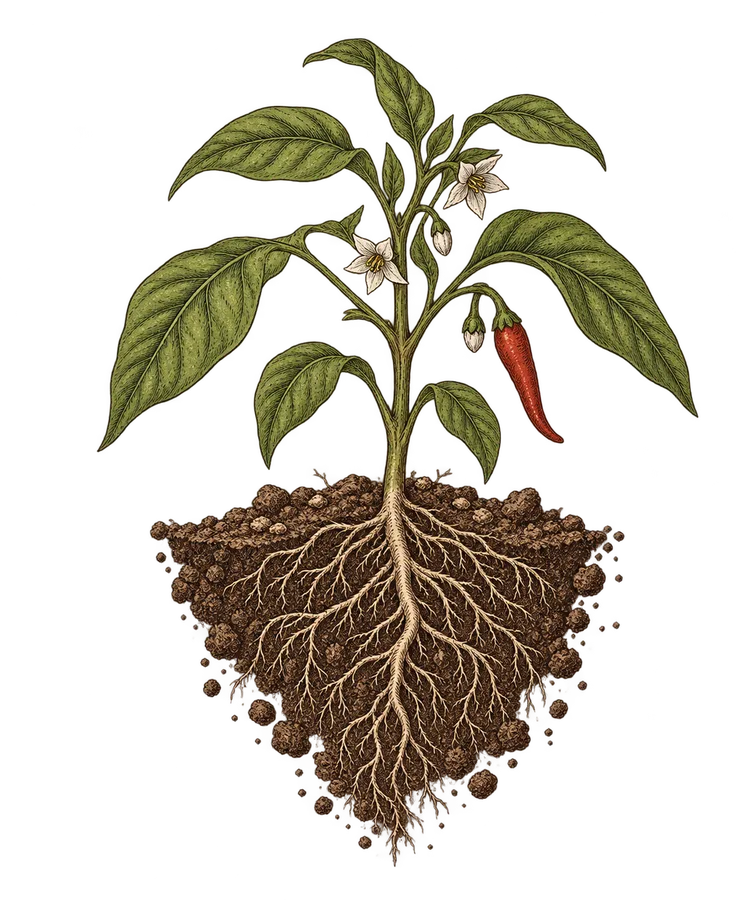
Most garden soils can grow good chiles once some compost is worked in. What chiles really care about is water: they want soil that stays evenly moist without ever staying soggy, and that is mostly a question of texture, drainage and organic matter.
What chiles need from soil
- Raised bed depth
- 30–60 cm (12–24 in) of soil for peppers on a hard surface7
- Container mix
- Equal parts peat moss, potting soil and coarse sand or perlite, plus a slow-release complete fertilizer9
- Pot size
- One plant per 22 cm (9 in) pot3
- Good drainage
- 2.5–7.5 cm (1–3 in) of water soaking away per hour5
New Mexico State University describes the ideal chile soil as a well-drained loam or sandy loam.2 The RHS puts it as well-drained, fertile and moisture-retentive.3 Both halves of that matter. Too little water makes chiles shed blossoms, set smaller fruit and develop blossom-end rot, while too much invites Phytophthora root rot, which makes a plant wilt and die suddenly.2 The soil has to hold enough water between waterings and let the surplus drain away.
The single most useful thing you can add is compost. The Chile Pepper Institute calls it one key to growing chiles well, because it improves workability, water-holding capacity, drainage and fertility.1 Before you add fertilizer, get a soil test: NMSU recommends basing fertilizer amounts on a soil analysis and asking your local extension office how to sample.2 Outside the US, a regional agricultural advisory service or a commercial soil lab does the same job.
Texture and drainage
Soil texture is the mix of three particle sizes: sand, silt and clay. A roughly even mix of the three is called a loam, and that is the ideal. Most garden soils lean one way or another and benefit from organic amendments.4 Clay particles are the smallest and leave little pore space, so clay soils drain slowly; sandy soils have more pore space and drain sharply.5
The jar test
All you need is a clear, straight-sided jar, a ruler and a marker. Clemson Extension’s method:4
- Sift the soil through a sieve or old colander to remove stones, roots and leaves.
- Fill the jar one-third full with soil, then top it up with clean water, leaving some space at the top.
- Cap it and shake hard until the soil becomes a uniform slurry.
- Set it on a level surface. After one minute, mark the layer that has settled at the bottom: that is sand.
- After two hours, mark the top of the next layer: that is silt.
- After two days (48 hours), mark the top of the clay layer, which settles on the silt.
- Measure each layer and the total height. Divide each layer by the total and multiply by 100 to get its percentage, then look up the combination on a soil texture triangle.4
The percolation test
A percolation test shows how your soil actually drains, including the effects of compaction and hard layers. Iowa State University Extension’s method: dig a hole at least 30 cm (12 in) deep and 10–30 cm (4–12 in) wide. Don’t dig when the soil is very wet, because a smeared, glazed hole wall gives a false result.5
Fill the hole with water and let it drain completely; this saturates the surrounding soil and may take a short while or a full day. As soon as it has drained, refill it, measure the water depth, wait 15 minutes and measure how far it has dropped. Multiply the drop by 4 to get the drainage rate per hour.5
| Water drop per hour | What it means |
|---|---|
| Less than 2.5 cm (1 in) | Poor drainage; improve it or grow in raised beds5 |
| 2.5–7.5 cm (1–3 in) | Desirable for most plants5 |
| More than 10 cm (4 in) | Very well drained; add organic matter to hold more water5 |
If yours drains poorly, note that NMSU links raised beds and drip irrigation to better water management and less Phytophthora root rot in chiles.2
Soil pH: range, testing, raising or lowering it
Soil pH runs from 0 to 14. Seven is neutral, lower is acidic and higher is alkaline.6 It matters because it affects which nutrients plants can take up: in very acidic soil, calcium, phosphorus and magnesium become less available, and above pH 6.5, phosphorus and most micronutrients become less available.6
Sources give slightly different targets. The Chile Pepper Institute recommends pH 6.5.1 The University of Maryland gives 6.2–6.8 for most vegetables,7 and Clemson gives 5.8–6.5.6 NMSU’s guide for New Mexico gardens lists a pH of 7.0–8.5 for chiles, so chiles plainly cope with alkaline ground.2 Aim for about 6.5 if you are building a bed or mix from scratch, but if your soil is mildly alkaline and your plants are healthy, there is no need to fight it.
Testing
A soil testing laboratory is more accurate than a DIY kit, and a basic test reports pH, nutrient levels and specific recommendations for lime, sulfur and fertilizer.7 If you build a new raised bed, test again a year later, once the materials have mixed and reacted.7
Raising pH (acidic soil)
- Ground agricultural limestone is the usual choice. The finer it is ground, the faster it works, and it reacts slowly in dry soil, so mix it in well and keep the soil moist.6
- Apply lime 2–3 months before planting to give it time to act.6
- Wood ash also raises pH and adds potassium and calcium, but it can raise pH sharply in sandy soil. Keep it away from seedlings and roots, and don’t overdo it.6
Lowering pH (alkaline soil)
- Elemental sulfur works gradually: soil bacteria convert it to sulfuric acid, which can take several months, and how fast depends on soil moisture and temperature.6
- Aluminum sulfate acts immediately, but too much can injure roots and aluminum can build up. Follow soil test rates and retest before repeating.6
Clay soils and soils high in organic matter resist pH change, so they need more lime or sulfur for the same shift than sandy soils do.6
Organic matter and compost
Compost improves almost any soil. In sandy soil it increases water-holding capacity and nutrient retention; in clay it improves aeration and drainage.2
For an in-ground bed, Iowa State suggests spreading 5–10 cm (2–4 in) of compost over the surface and working it into the top 15–30 cm (6–12 in) with a spade or fork. Don’t over-till: frequent rototilling breaks down the aggregates you are trying to build.5
The Chile Pepper Institute notes that most gardeners can grow good chiles simply by adding compost and aged manure to the soil they already have.1 If you prefer not to dig, the RHS suggests mulching the soil ahead of time and planting straight into the mulch.3
More is not always better. In a raised bed, the University of Maryland suggests organic matter should make up 25–50% of the soil by volume.7 Too much compost causes its own problems: it dries out fast and can repel water once dry, and manure adds a lot of phosphorus, so use it only when a soil test shows a need.8
Raised beds
Raised beds help with heavy, wet or compacted ground. Their soil warms faster early in the season, and they let you garden where the native soil is compacted or poor.8 For chiles the bigger benefit is drainage: NMSU links raised beds and drip irrigation to less Phytophthora root rot.2
Depth
On open ground, a bed doesn’t have to hold the whole root system, because roots grow down through it into the soil below.7 The simplest raised bed is just a flat-topped mound of soil 15–20 cm (6–8 in) high, and you don’t need a barrier underneath; one is likely to stunt root growth.8 On a hard surface such as a patio or driveway, roots have nowhere else to go: the University of Maryland recommends 30–60 cm (12–24 in) of soil for peppers.7
Keep beds narrow enough to reach the middle without stepping in and compacting the soil: for a mounded bed, about 75 cm (2.5 ft) wide if you can reach it from one side only, or up to 1.5 m (5 ft) if you can reach it from both.8
What to fill it with
- On soil: about one-half to two-thirds topsoil and one-third to one-half plant-based compost. Choose loam or sandy loam topsoil; avoid very sandy or clay soil.8
- On compacted clay: loosen the ground first, then add compost and topsoil in a 1:2 or 1:1 ratio.7
- On a hard surface: compost and a soilless growing mix in a 1:1 ratio. You can add topsoil (up to 20% by volume) if the bed is at least 40 cm (16 in) deep.7
Don’t fill a raised bed with potting soil: it suits pots but dries out too quickly in a bed. Raised beds dry out faster than open ground anyway, and the taller the bed, the more often you will need to water.8
Container potting mix
Chiles do well in pots,3 but ordinary garden soil usually doesn’t. Unless yours is a sandy loam or sand, it is too heavy. Clay is worse in a container than in the ground: it holds too much water and too little air when wet, and shrinks away from the pot’s sides when dry.9
Packaged potting soil can make a good container mix. Very light peat-based soilless mixes are generally too light for vegetables: they may not support the plant well, a light pot can blow over in wind, and they contain few nutrients; add potting soil if you use one.9
To mix your own for a lot of pots, Clemson Extension suggests one part peat moss, one part potting soil and one part clean coarse builder’s sand or perlite, with a slow-release complete fertilizer. You may need lime to bring the pH to around 6.5.9 If you would rather avoid peat, the RHS recommends peat-free multi-purpose compost; commercial peat-free composts are made from ingredients such as loam, composted bark, coir and sand.3
The RHS suggests one chile plant per 22 cm (9 in) pot, or three plants per standard growing bag.3 Whatever the pot, it must have drainage holes so roots never stand in water. Water until water runs out of the holes; in hot sun, pots may need watering daily or even twice a day.9
Fixing clay and sandy soil
Clay
- Add organic matter, not sand. Iowa State recommends compost to improve poorly drained soil because it builds structure and pore space.5
- Never work it wet. Keep off the soil as much as you can and never dig or till it wet, to avoid compacting it. Spading, trenching or aerating can break up a hard layer, and mixing in organic matter at the same time helps further.5
- Loosen without flipping. The University of Maryland suggests driving a garden fork into compacted clay, rocking it back and forth, and moving along 15–20 cm (6–8 in) at a time, without turning the soil over. Then add compost and topsoil on top.7
- Grow a cover crop between chile crops. Cover crops add organic matter, and their roots help break up compacted soil.5
- Build up. If the percolation test shows less than 2.5 cm (1 in) per hour, a raised bed lets you build the soil conditions you want on top of it.5
Sand
- Add compost to raise water-holding capacity and nutrient retention.2
- Watch for root-knot nematodes. These microscopic worms can be a problem in sandy soil. NMSU suggests rotating with a cabbage-family crop such as broccoli or cabbage and building up organic matter with compost.2
- Go easy on pH amendments. Sandy soil changes pH more readily than clay, so it needs less lime, and wood ash can push the pH up sharply.6
Sources
- Growing Tips Chile Pepper Institute, New Mexico State University · accessed 2026-09-27
- Growing Chile Peppers in New Mexico Gardens (Guide H-240) New Mexico State University Cooperative Extension Service · accessed 2026-09-27
- How to grow chilli peppers Royal Horticultural Society (RHS) · accessed 2026-09-27
- Soil Texture Analysis: The Jar Test (HGIC 1656) Clemson Cooperative Extension, Home & Garden Information Center · accessed 2026-09-27
- Testing and Improving Soil Drainage Iowa State University Extension and Outreach · accessed 2026-09-27
- How to Change Soil pH (HGIC 1650) Clemson Cooperative Extension, Home & Garden Information Center · accessed 2026-09-27
- Soil to Fill Raised Beds University of Maryland Extension · accessed 2026-09-27
- Raised bed gardens University of Minnesota Extension · accessed 2026-09-27
- Container Vegetable Gardening (HGIC 1251) Clemson Cooperative Extension, Home & Garden Information Center · accessed 2026-09-27