
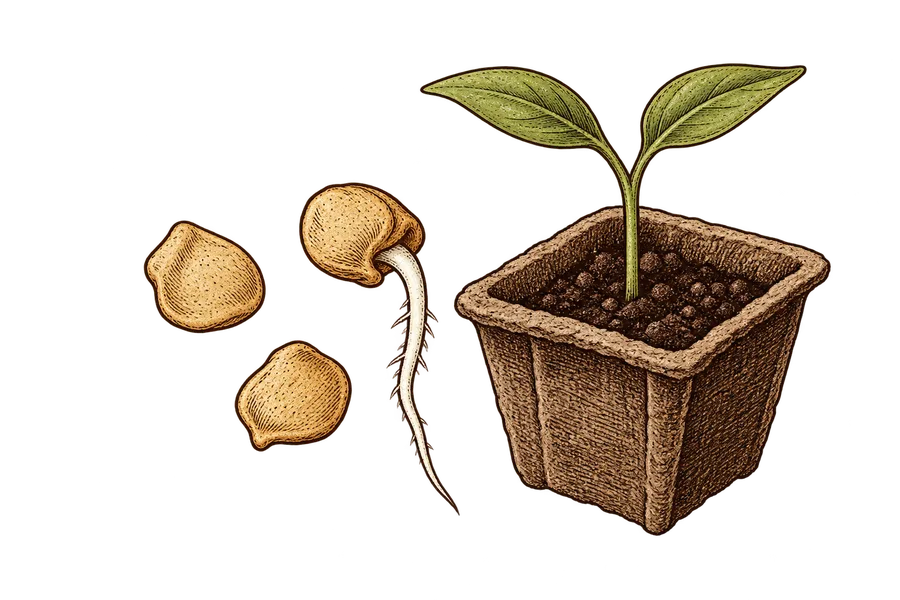
Chiles need a long, warm season, longer than most places give them outdoors. The answer is to sow indoors, raise sturdy plants under lights, and plant them out once the weather has warmed. The temperatures behind each step are explained in the Climate chapter; the ground they go into is covered in Soil and Nutrients.
When to start (weeks before last frost)
- Sow indoors
- 9 weeks before your last frost, the middle of the Chile Pepper Institute’s 8–10 weeks1
- Plant out
- 14 days after your average last frost; Utah State says to wait until all frost danger has passed4
- Germination
- Best at 21–27 °C (70–80 °F)1
Count back from your average last spring frost date. The Chile Pepper Institute says to start seed indoors 8 to 10 weeks before the last expected frost,1 and the University of Maryland gives the same 8 to 10 weeks before the average frost-free date, adding that some types and cultivars need 12 weeks.2 This guide uses the middle of that range: sow 9 weeks before your last frost.1 The Zones chapter explains how to find your frost dates.
Other guides count from planting-out day instead. Minnesota says about eight weeks before planting outside.3 Utah State allows 8–10 weeks to grow transplants,4 and Penn State’s table for field transplants gives peppers 6–8 weeks.5 Planting out comes two weeks after the frost date (see Transplanting below), so sowing 9 weeks before it gives plants about 11 weeks from seed to garden. That is generous, which leaves room for slow chinense seed. If you grow only quick C. annuum types, you can sow a week or two later.
If your nights stay below 10 °C (50 °F) for weeks after your last frost, count back from the date you will actually transplant instead; the climate tool on the Grow page does this.3
Germination temperature and time (why chinense types are slow)
Chile seed needs warmth, oxygen and moisture to germinate, and even in good conditions it can be slow and irregular.1 Warmth matters most. The Chile Pepper Institute reports higher germination rates at 21–27 °C (70–80 °F), and faster germination at 32–38 °C (90–100 °F).1 Minnesota calls a soil temperature of 21 °C (70 °F) ideal and says warm soil is better than cool.3 Cold slows everything down: Penn State notes that pepper seed germinates in 8 days at 30 °C (86 °F) but takes more than 13 days at 14 °C (58 °F).5
A few practical points for sowing:
- Depth. Sow about 6 mm (¼ in) deep in a sterile, soilless seed-starting mix.3
- One seed per cell. Small individual cells or pots keep roots from tangling, so seedlings are not torn apart later.7
- Soaking. The Chile Pepper Institute says soaking seed for 2–3 days can speed germination.1
- Moisture. Keep the mix moist but not wet.6 A clear dome over the tray holds in moisture and heat, and comes off once seedlings are tall enough to touch it.7
Chinense types are slower
Habaneros, Scotch bonnets and superhots such as Carolina Reaper and Trinidad scorpion belong to Capsicum chinense.9 How slow their seed can be shows in UF/IFAS Extension’s advice on the datil, a Florida pepper it classes with the chinense species and puts at habanero heat: keep the soil at 24–27 °C (75–80 °F) and wait patiently 10 to 20 days for germination.6 Compare that with the 8 days Penn State gives for pepper seed in general at 30 °C (86 °F).5
What this means in practice: give chinense seed steady bottom heat, don’t give up on a tray after a week, and sow at the early end of the range. Chinense plants are slow to ripen, too: the University of Maryland says habanero types ripen 90–120 days from transplanting.2 The Climate chapter covers how the species differ.
Heat mats and grow lights
Heat mats
Minnesota suggests a seed-starting heat mat to keep the tray at 27–32 °C (80–90 °F) until seedlings emerge, and warns that the mat dries the mix out faster, so check moisture often.3 Bottom heat matters because potting mix in indoor containers can run as much as 3 °C (5 °F) cooler than the room air, and warm mix also helps prevent damping off, the death of tiny seedlings from pathogens at the surface of the mix.7 If your lights are on a timer, don’t plug the heat mat into it.7
Once seedlings are up, they want less heat than the seed did. Utah State germinates pepper seed at 27 °C (80 °F) and then grows the seedlings on at 18–24 °C (65–75 °F).4 The RHS takes seedlings out of the propagator as soon as they appear and keeps them at 16–18 °C (60–64 °F) in bright light.8
Grow lights
Minnesota recommends fluorescent or LED lights over natural light alone, even in a greenhouse; plain “cool white” tubes are adequate.7 The key is keeping them close:
- Height. No more than 10 cm (4 in) above the seedlings, and 5 cm (2 in) is ideal. Too little light is the main cause of long, skinny stems.7 Hang lights on chains so you can raise them as the plants grow.7
- Hours. 12–16 hours a day, with a dark period each night; don’t leave lights on around the clock.7 Utah State suggests 14–16 hours for peppers.4
- Windowsills. The RHS says a warm windowsill is fine for germinating seed,8 but Minnesota warns that seedlings without enough bright light directly overhead elongate and lean over.3
Potting up
Seedlings grow out of small cells quickly. Move them on in stages rather than straight into a big pot:
- First move. The RHS moves each seedling into its own module or small pot when it is 2–3 cm (1 in) tall.8 For datil peppers, UF/IFAS moves seedlings into 5–10 cm (2–4 in) pots once the first true leaves appear.6
- Later moves. When roots begin to show through the drainage holes, the RHS moves plants into 13 cm (5 in) pots.8 Minnesota’s rule of thumb is a container 2.5–5 cm (1–2 in) wider than the one the seedling has outgrown.7
- Handle by a leaf. Never hold a seedling by its stem, which you can crush; steady it by a leaf instead.7
Seedlings don’t need fertilizer until they have several sets of true leaves; after that, Minnesota suggests a general-purpose soluble fertilizer at a quarter strength once a week in a soilless mix,7 and UF/IFAS starts datil seedlings on half strength at their first move.6 The Nutrients chapter covers feeding after transplanting.
Pepper plants sometimes flower indoors. Minnesota says to pinch off the flower buds until just before planting out.3 A good transplant, by Utah State’s description, is stocky and dark green, with 6–9 leaves and 13–20 cm (5–8 in) tall.4
Hardening off
Plants raised indoors have never felt full sun, wind or swings in temperature. Put them straight outside and their leaves can scorch, or they can wilt and die.7 Oregon State notes that transplants that weren’t properly hardened off can get sunscald on their leaves.9 Sources give hardening off one to three weeks: Minnesota’s pepper guide says a week or two,3 its seed-starting guide says two weeks,7 and the RHS says two to three weeks for chiles.8
- Start about two weeks before you plan to plant out. Put the plants outside for a few hours in the shade during the warm afternoon, sheltered from wind, and bring them in before it cools at night.7
- Each day, leave them out a little longer and give them a little more direct sun.7
- Bring peppers indoors if the night will drop below 13 °C (55 °F).3
- By the end, unless frost is forecast, they can stay out in a sunny spot until planting day.7
Minnesota also suggests cutting back on watering once plants are 10–13 cm (4–5 in) tall and six to eight weeks old.3 Throughout, the Chile Pepper Institute’s rule applies: expose seedlings to outdoor temperatures, but not freezing ones.1
Transplanting (night and soil temperature, spacing)
When
Chiles go out after the last frost, and once the air and soil have warmed. Utah State says to transplant when the soil reaches 16 °C (60 °F) or after all frost danger has passed.4 This guide turns that into a date: plant out 14 days after your average last frost. None of the extension sources gives a fixed number of days; the 14 days is a safety margin this guide adds to Utah State’s rule,4 because an average last frost date is only an average, and in some years frost comes later.
The date is a starting point; the temperatures decide. The Climate chapter sets out the conditions: night lows staying above 10 °C (50 °F)3 and soil at least 16 °C (60 °F).9 The 10 °C (50 °F) night is the floor, not the ideal, and warmer soil is better: the University of Maryland says plants set out before the soil reaches 18 °C (65 °F) tend to “just sit there”.2 If your nights are still cool on planting day, wait. Utah State notes that black plastic mulch and row covers let you plant earlier,4 and the RHS warms the soil under cloches for a couple of weeks before planting.8
How
- Pick your moment. Transplant in late afternoon or on a cloudy, calm day,3 and water the plants well beforehand.3
- Keep the root ball whole. Leave as much soil as possible around the roots, and don’t bury the plant deeper than its original soil ball.9
- Peat pots. Bury the rim completely or trim it to soil level; an exposed rim wicks water out of the root ball.3,7
- Remove flowers. Pick off any flowers or fruit before planting; transplants carrying them establish slowly.4
- Water in. Firm the soil around the roots and water the transplant.3
Spacing
| Source | Between plants | Between rows |
|---|---|---|
| University of Minnesota | 46 cm (18 in) | 76–91 cm (30–36 in)3 |
| Oregon State | 36–46 cm (14–18 in) | 61–91 cm (24–36 in)9 |
| University of Maryland | 30–61 cm (12–24 in) | 76–91 cm (30–36 in)2 |
| RHS | 38–45 cm (15–18 in); dwarf types 30 cm (1 ft) | Not given8 |
Minnesota’s 46 cm (18 in) between plants suits most chiles.3 The RHS varies spacing by variety, down to 30 cm (1 ft) for dwarf types.8 For containers, the Soil chapter covers pot sizes and mixes.
In the Southern Hemisphere and the tropics
Everything in this chapter is timed from your frost date, so it works in either hemisphere. South of the equator the seasons are reversed: your last spring frost falls in what northern calendars call autumn. Count 9 weeks back from your last frost to sow,1 and plant out 14 days after it once the temperatures are right.4
Where it never frosts, there is no date to count from, and temperature takes over completely. In the subtropics the planting window usually opens when nights reliably stay above 10 °C (50 °F)3 and the soil is warm, and it can close again in the hottest part of the year: the University of Maryland says very hot weather, especially nights above 24 °C (75 °F), slows or stops pod production.2 Northeast Florida gives a good model: UF/IFAS says datil seed can be started indoors in late winter and planted out once frost danger has passed, and a second crop sown in midsummer for planting out in early autumn.6 In the true tropics, where it is warm enough most of the year, plan around the rains instead, so that young plants don’t go out into waterlogged ground. The Soil chapter covers drainage, the Climate chapter covers heat stress and wet-weather disease, and the Zones chapter explains how to read your own season.
Wherever you are, the slow species need more time: datil peppers need around five months of frost-free weather to mature.6 In a short season, sow C. chinense early and plan on row covers or a greenhouse.
Sources
- Growing Tips Chile Pepper Institute, New Mexico State University · accessed 2026-09-27
- Growing Peppers in a Home Garden University of Maryland Extension · accessed 2026-09-27
- Growing peppers University of Minnesota Extension · accessed 2026-09-27
- How to Grow Peppers in Your Garden Utah State University Extension · accessed 2026-09-27
- Seed and Seedling Biology Penn State Extension · accessed 2026-09-27
- Gardening with Datil Peppers UF/IFAS Extension St. Johns County · accessed 2026-09-27
- Starting seeds indoors University of Minnesota Extension · accessed 2026-09-27
- How to grow chilli peppers Royal Horticultural Society (RHS) · accessed 2026-09-27
- Grow Your Own Peppers (EC 1227) Oregon State University Extension Service · accessed 2026-09-27