
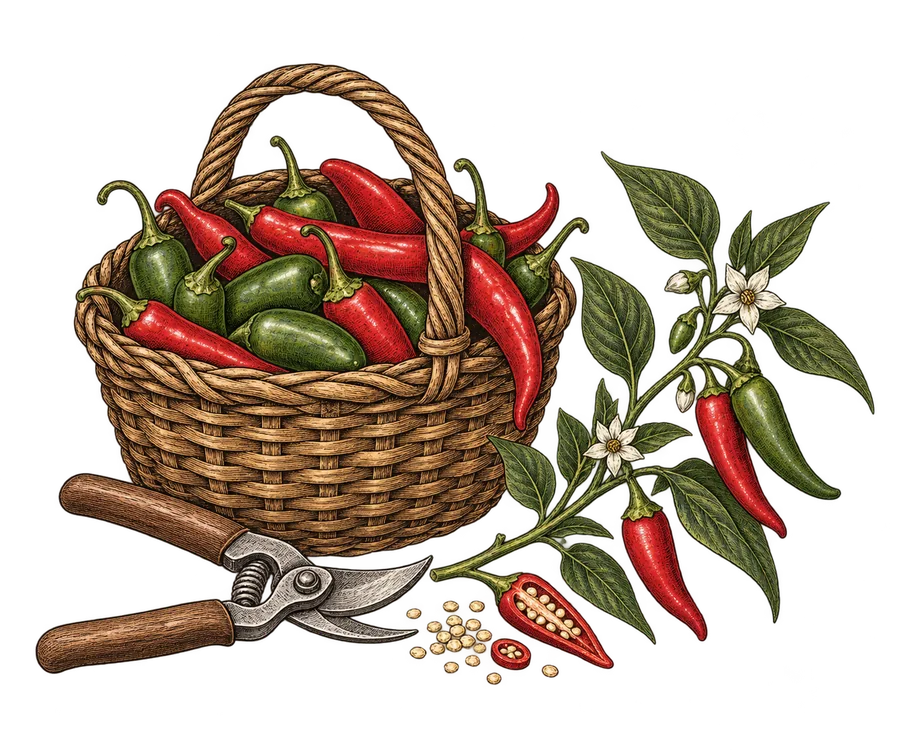
This last chapter covers what can go wrong and what to do with the crop when things go right, through to saving seed that comes true.
Common pests
New Mexico State University (NMSU) lists flea beetles, cutworms, thrips, leafhoppers and aphids as damaging young plants, with hornworms and cabbage loopers later in the season.1 Start with the least drastic control: check plants often, pick off what you can, hose off soft-bodied pests and spare the predators that eat them.
| Pest | Signs | Control |
|---|---|---|
| Aphids | Green or black soft-bodied insects under the leaves; leaves crinkle or curl and look shiny or sticky from honeydew. They can spread viruses.4 | A strong stream of water to knock them off, or insecticidal soap4 |
| Spider mites | Stippling of light dots on the leaves, sometimes bronzing, then yellowing and leaf drop, often with fine webbing. Worst in hot, dusty conditions and on water-stressed plants.5 | Keep plants watered; spray leaf undersides forcefully with water; avoid broad-spectrum insecticides, which kill mite predators. If needed, insecticidal soap or oil, but not on water-stressed plants or above 32 °C (90 °F), and test on a few leaves first.5 |
| Flea beetles | Small black beetles; tiny holes chewed in seed leaves and leaves. They can weaken or kill seedlings.4 | Row covers on young plants screen out many insect pests;1 Utah State suggests an insecticide dust at seeding or transplanting4 |
| Hornworms, fruitworms and other caterpillars | Larvae eat leaves and fruit; look for damaged leaves and black droppings.4 | Pick them off by hand; for heavy infestations, Bt (Bacillus thuringiensis)4 or, in larger gardens, “soft” insecticides such as Bt or spinosad2 |
| Beet leafhopper | Spreads curly top disease.1 Pepper viruses spread by leafhoppers turn leaves light green, mottled, malformed, dwarfed and curled.4 | Row covers over young plants early in the season1 |
| Root-knot nematodes | Microscopic soil roundworms, mainly a problem in sandy soil1 | Rotate with a cabbage-family crop such as broccoli and add compost;1 choose nematode-resistant cultivars2 |
Which pesticides are allowed differs between countries. Clemson Extension notes that registrations and permitted uses change, and says to follow all label directions, precautions and restrictions.2 NMSU suggests asking your local extension office for current control measures;1 outside the US, ask your regional agricultural advisory service.
Common diseases
Which diseases matter depends on where you grow. NMSU names Verticillium wilt, Phytophthora root rot and curly top as the common ones in New Mexico.1 In humid South Carolina, Clemson rates bacterial wilt and bacterial leaf spot as the most troublesome in home gardens, ahead of viruses, Fusarium wilt, Pythium root rot, Cercospora leaf spot, southern blight and anthracnose fruit rot.2
- Leaf spots and blights: dark spots on stems, leaves or fruit that spread until the foliage dies. Utah State says cool, wet conditions favour them: don’t water overhead late in the day, let the soil dry between waterings, and use a suitable fungicide once the disease is identified.4 The Climate chapter covers the weather bacterial spot favours and how it spreads.
- Wilts: leaves wilt from the bottom up. Use resistant varieties, crop rotation and soil solarization.4 Rotating with sweet corn discourages Verticillium wilt.1
- Phytophthora root rot: NMSU says drip irrigation and raised beds reduce it by keeping water under control;1 see Watering and care and Soil.
- Viruses: twisted leaves and bumps on the fruit. They can’t be cured, so pull out infected plants.3 They spread through aphids and leafhoppers, by brushing against infected plants, and from tobacco products, so control aphids, remove infected plants and weeds, and don’t use tobacco while handling plants.4
Prevention does most of the work. Clemson recommends certified disease-free seed and transplants, planting peppers, tomatoes, eggplant or potatoes in the same spot no more than once every three years, clearing plant debris and volunteer pepper plants each year, and choosing resistant cultivars.2
Blossom-end rot, sunscald and flower drop
These are disorders, not infections: the plant is reacting to its conditions.
Blossom-end rot makes the flower end of the fruit dry, brown or black. Utah State attributes it to a localized calcium deficiency brought on by poor water management, excess nitrogen, root pruning and drought stress, and recommends even soil moisture in hot weather, especially at flowering, plus mulch.4 The Nutrients chapter explains the calcium link and why calcium sprays are unlikely to help.
Sunscald leaves flat, tan areas on fruit exposed to intense direct sun, typically on small plants or under a gap in the leaf canopy.3 It happens in hot, dry weather, and plants with good leaf cover suffer less; leaf diseases that strip foliage expose fruit too.4
Flower drop is a sign of stress. NMSU links under-watering to shed blossoms and smaller fruit.1 Minnesota notes flowers can drop when hot days combine with hot nights,3 and Maryland says evenings above 24 °C (75 °F) slow or stop pod production.6 Sources set the heat threshold at different temperatures; the Climate chapter covers heat stress in detail.
When to harvest
- Mature green
- 45–55 days after pollination under ideal conditions1
- Full colour
- 35–45 days from flowering, depending on temperature and variety4
- From transplanting
- 70–85 days for most sweet and hot types; 90–120 days for habaneros6
You can pick chiles green or ripe. For a green crop, NMSU says to pick before the fruit changes colour, once it is fully developed, firm and crisp when squeezed; cool weather delays maturity.1 Many varieties are good at either stage: jalapeños are used green and Hungarian wax peppers yellow.3 Left on the plant, most varieties turn red, yellow, purple, orange or brown. Maryland notes that sweet types get sweeter and richer in vitamins A and C as they colour, and that fruit doesn’t ripen further once picked.6
Cut the fruit off rather than pulling it, because pepper stems are brittle2 (as the Watering and care chapter notes). Plants keep flowering and setting fruit as long as you keep picking.3 Wear rubber gloves when handling hot chiles or cleaning out seeds.6
The first autumn frost ends the season. Before it arrives, pick all fruit that is mature green or has started to colour,4 or pull whole plants just before a killing frost and hang them upside down somewhere warmer, such as a garage, for the fruit to ripen.6 In the Southern Hemisphere the rule is the same; the first frost just falls in the opposite half of the calendar. Your chile season gives the typical first frost date for your town.
How ripeness changes heat
Heat comes from capsaicinoids. NMSU says glands on the placenta, the pale tissue in the centre of the pod, produce them, and that seeds are not a source of heat, though they can absorb some when cooked.1 Minnesota says capsaicin is in the seeds and the whitish membrane.3 They disagree about the seeds, but Minnesota’s advice works either way: removing seeds and membrane before cooking makes a chile milder.3
Red chiles are often said to be hotter than green ones. None of this guide’s extension sources states a rule, and the research is less tidy. A 2020 study of two ornamental pepper varieties summarises earlier work: in most studies, capsaicinoids rise during early fruit development, peak roughly 40 days after the flower opens, then gradually break down, losing 30–65% depending on the cultivar.7 In the study itself, one variety peaked at 41 days and had lost 44% a week later; the other rose and fell several times before peaking at 69 days. Very young fruit was mildest in both, and ripe red fruit still held relatively high levels.7
So a small, immature pod is likely to be milder, but a fully red pod is not reliably hotter than a mature green one, and varieties differ. What ripening reliably changes is sweetness: fully coloured peppers are sweeter.2 Conditions matter too; NMSU lists water stress, temperatures that are too cool or too hot, disease and insect pressure as influences on pungency.1
Drying and storing
Fresh chiles keep only a few weeks. Maryland recommends 7–10 °C (45–50 °F) at 95% relative humidity for 2–3 weeks,6 Clemson the same temperature at 80–90% humidity,2 and Utah State 10–13 °C (50–55 °F) for 1–2 weeks, warning that the fruit suffers chilling injury in a fridge.4 The Climate chapter covers chilling injury.
For longer storage, dry them. NMSU says fruit at its mature colour can dry on the plant, or be picked fully ripe and hung up by the stems; red chiles are traditionally tied into long strings called ristras.1 NMSU’s drying guide says to string whole red pods on a cord, or hang them in bunches stem side up, somewhere with good air circulation. They are done when shrunken, dark red and still flexible.8
For green chiles, the same guide says to loosen the skins over a flame or in boiling water, peel, split and seed the pods, then dry them until crisp and brittle, which takes 4–8 hours in an electric dehydrator. In an oven, use the lowest setting but not below 60–66 °C (140–150 °F), with an electric oven’s door open at least 2.5 cm (1 in) to let moisture out.8 Somewhere humid, dry indoors: NMSU recommends an oven or dehydrator over the sun for vegetables, and even for fruit wants days of at least 29 °C (85 °F) with humidity below 60%.8
Condition dried chiles for a week in a covered container; if moisture beads form, dry them further. Then store them in freezer bags with the air pressed out, inside tight-lidded containers, somewhere cool, dark and dry. NMSU says dried foods keep a month at room temperature, three months refrigerated and up to a year frozen.8
Saving seed (isolation distance)
Save seed from open-pollinated or heirloom varieties. Seed from a hybrid, usually labelled F1, generally won’t grow into plants like the parent.10
Chile flowers pollinate themselves easily, but insects also cross them. NMSU says insects readily cross varieties within a species: a jalapeño and a bell pepper (both Capsicum annuum) will cross, but a jalapeño is highly unlikely to cross with a habanero (C. chinense).9 Maryland is more cautious, saying insects can cause considerable crossing within and between species.6 Crossing doesn’t change this year’s fruit, so sweet peppers next to hot ones won’t turn hot;6 it shows up in plants grown from the seed.10
How far apart
- University of Maryland Extension
- 150 m (500 ft) between varieties, or screen plants from insects6
- Seed Savers Exchange, via Illinois Extension
- 91–488 m (300–1,600 ft)10
The sources disagree. Maryland says saved seed gives unpredictable results unless plants are screened from insects or 150 m (500 ft) apart.6 University of Illinois Extension, using Seed Savers Exchange figures, gives 91–488 m (300–1,600 ft).10 NMSU gives no figure, noting that the distance needed depends on the number of plants, the pollinators, other pollen sources and barriers.9
Few gardens can manage that, so use a barrier: NMSU suggests seed cages or blossom bags,9 and Illinois lists paper, row-cover or nylon bags over flowers or whole plants, or staggered planting so varieties don’t flower together.10
Collecting and storing seed
Take seed from fully mature fruit: usually red, though depending on variety it may be yellow, green, orange, purple or brown. If a freeze is coming, NMSU says to hang the whole plant in a garage or shed until the pods colour fully. Fleshy fruit can mould inside unseen, so cut a few open; if mould appears, remove the seeds and let them finish maturing somewhere cool and dark at 18–24 °C (65–75 °F).9
Wearing gloves for hot chiles, scrape the seeds from the core. Keep ivory or yellow- or orange-tinted seeds and discard dark ones. Dry them on a tray until a seed snaps when bent.9
Store seed cool, dry and dark, below 10 °C (50 °F) at 50% humidity or lower; a refrigerator and a tight-lidded glass jar work well, and most good seed stored this way stays viable for at least 3–5 years.9 Label it with the variety and date.10
Sources
- Growing Chile Peppers in New Mexico Gardens (Guide H-240) New Mexico State University Cooperative Extension Service · accessed 2026-09-27
- Pepper (HGIC 1316) Clemson Cooperative Extension, Home & Garden Information Center · accessed 2026-09-27
- Growing peppers University of Minnesota Extension · accessed 2026-09-27
- How to Grow Peppers in Your Garden Utah State University Extension · accessed 2026-09-27
- Spider Mites (Pest Notes Publication 7405) UC Statewide Integrated Pest Management Program, University of California Agriculture and Natural Resources · accessed 2026-09-27
- Growing Peppers in a Home Garden University of Maryland Extension · accessed 2026-09-27
- Content of Capsaicinoids and Capsiate in 'Filius' Pepper Varieties as Affected by Ripening Vázquez-Espinosa et al., Plants (Basel) 9:1222, 2020 (peer-reviewed) · accessed 2026-09-27
- Drying Foods (Guide E-322) New Mexico State University Cooperative Extension Service · accessed 2026-09-27
- Vegetable Seed Saving for Home Gardeners and Small-scale Farmers (Guide H-262) New Mexico State University Cooperative Extension Service · accessed 2026-09-27
- How to Save Seeds University of Illinois Extension · accessed 2026-09-27